
Every aspiring founder eventually asks the same quiet question: do I actually have what it takes to build a successful startup? It's a hard thing to answer honestly on your own. Your idea might be brilliant, but great companies aren't built on ideas alone. They're built by people. And it turns out the traits that make a great founder can be measured.
That's the whole premise behind the Entrepreneur DNA Assessment, a founder personality test the Founder Institute has been refining since 2009. Here's what it measures, what actually makes a good entrepreneur, and how to find out where you stand.
What Is the Entrepreneur DNA Assessment?
When the Founder Institute launched in 2009, it set out to empower talented, motivated people to build enduring companies. But with applications pouring in from around the world, it needed an objective way to answer one question at scale: who is most likely to succeed as a founder, regardless of their idea, location, or background?
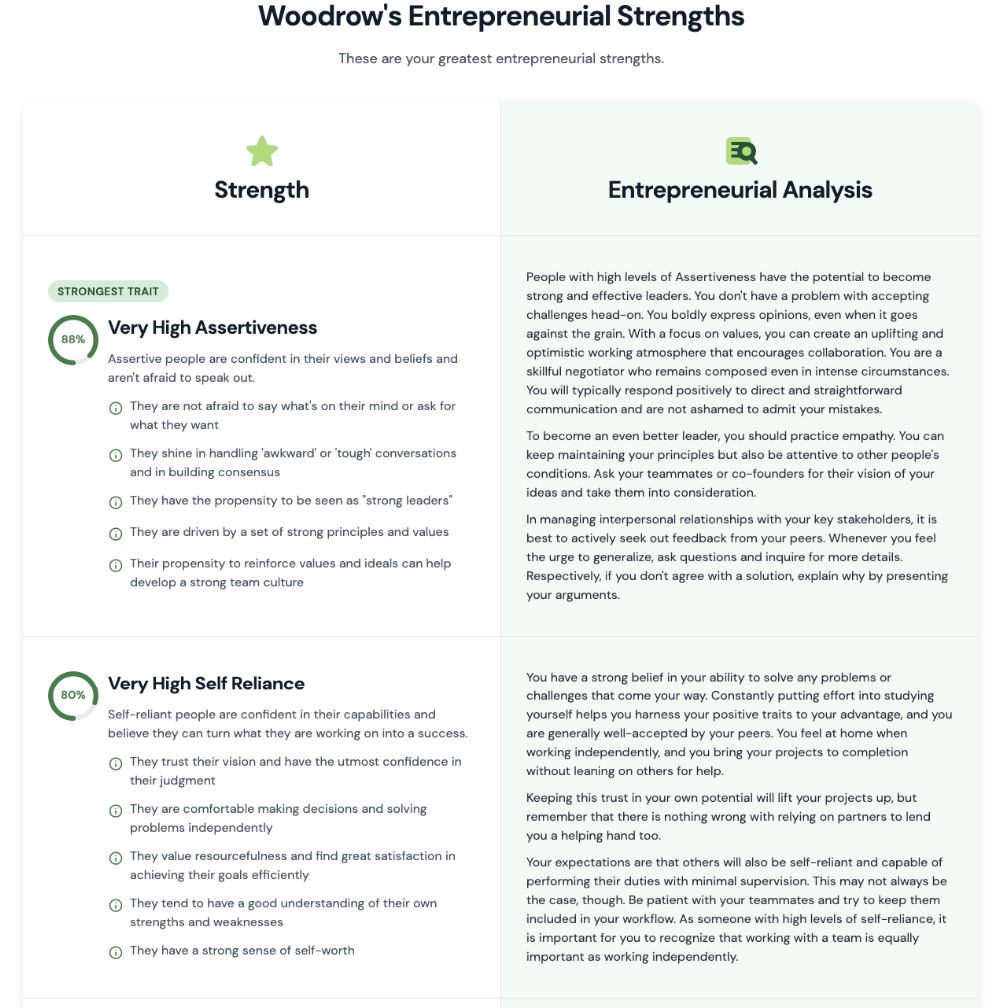
Working with leading social scientists, FI developed the Entrepreneur DNA Assessment, an online battery of tests that quantifies the single biggest variable in startup success: the founder. Rather than subjectively judging startup ideas, the assessment measures the person behind them. It takes about 30 minutes, analyzes 25 dimensions of entrepreneurship, and has now been taken by more than 250,000 applicants across six continents, feeding into the 9,000+ companies launched through FI programs.
Why Personality Predicts Startup Success More Than Your Idea
This is the part that surprises most people. Ideas change constantly in the early days of a company, but the founder is the constant. So instead of betting on a pitch, FI built its admissions criteria for its pre-seed accelerator around psychographic testing that scores the traits proven to correlate with building great companies.
What makes the assessment unusually credible is how it learns. Accepted founders join an intensive four-month program where they're rated weekly by peers, program leaders, and mentors. After graduation, FI keeps tracking how their companies perform in the real world, then feeds all of that data back into the model. Through continuous data, regression analysis from PhDs, and frequent updates, the result is a statistically validated test for spotting high-potential entrepreneurs, backed by more than 17 years of research.
What Makes a Good Entrepreneur? The Traits That Matter
So what does strong founder DNA actually look like? The assessment evaluates 25 dimensions, and a handful of them capture what strong founders tend to have in common:
Perseverance. Are you resilient and intrinsically motivated to keep going when things get hard? Few traits matter more.
Proactivity. Are you a self-starter who takes initiative in unclear, undefined environments, without waiting for permission?
Problem solving and high fluid intelligence. Can you quickly learn a new rule set and apply it to solve a novel problem? On a constantly shifting playing field, founders have to recognize patterns and adapt fast.
High openness. The best entrepreneurs are endlessly curious. They seek out new experiences and knowledge, and they challenge accepted norms rather than settling for the status quo.
Moderate agreeableness. Great founders balance cooperation with a willingness to push back. Warm and considerate most of the time, but straightforward and firm when the moment calls for it.
Collaboration. Can you work effectively as part of a team? Building a company is rarely a solo act.
One finding that catches people off guard: you don't have to be a young college dropout. FI's data shows that founders aged 34 and up, with real domain expertise and management experience, often have the advantage.
The Traits That Hold Founders Back
Just as important are the traits that can quietly limit you. The assessment flags patterns like predatory aggressiveness, excuse-making, deceit, emotional instability, and narcissism, all of which tend to work against long-term founder success.
And then there are the surprises, the traits people assume matter but don't. FI has seen no meaningful correlation between IQ and founder success, so much so that it removed IQ from the assessment several versions ago. Conscientiousness, which measures responsibility and industriousness, also shows a weaker link to success than most would expect. In other words, being the smartest or most diligent person in the room is not what makes a great entrepreneur.
The 9 Entrepreneur DNA Profiles: Which One Are You?
After analyzing the scores of successful founders, FI's social scientists found that most fit into nine core personality profiles. There's no single "right" type, which is exactly the point. Great founders come in different shapes:
The Hustler, an outgoing go-getter who can sell just about anything. The Innovator, adventurous and forward-thinking, always experimenting. The Machine, dutiful and dependable, who ships on schedule every time. The Prodigy, blessed with instinctive business sense. The Strategist, a creative and tactical thinker with a plan for everything. The Visionary, constantly spotting new ideas and new ways to act on them. The Architect, disciplined and thoughtful, with a gift for executing on big visions. The Inventor, always uncovering unique market insights that keep them a step ahead. And the Achiever, who simply refuses to lose and will outwork anyone.
Recognizing your profile helps you lean into your natural strengths and shore up your blind spots, which is often the difference between a good founder and a great one.
How to Find Out Your Entrepreneur DNA
Here's the encouraging part. The first step is simply knowing where you stand, and that's exactly what the assessment gives you: a clear read on the strengths that give you an edge and the blind spots worth watching. From there, FI, now an AI-native company builder, is built to help founders turn that insight into progress, with experienced mentors and a structured program behind them.
When you apply to the Founder Institute, you can take the assessment and get a free Entrepreneur DNA Report Preview immediately after finishing. In about 30 minutes, you'll see the traits that give you an edge as a founder, the ones that may hold you back, and how you compare to the average scores of 250,000+ applicants worldwide.
As Aaron Patzer, founder of Mint.com, once put it, FI appears to have "developed an assessment that any population, any city, university, or country could use to determine who among them has the best shot at succeeding as an entrepreneur."
The only way to know your score is to take it. Ready to find out if you have the DNA of a successful founder?
Take the Entrepreneur DNA Assessment and get your free Report Preview today.