

Learning how to build a unicorn with AI agents comes down to one shift in thinking: you are no longer a founder doing the work, you are a founder directing a team of agents that does the work for you. Get that right, and a single person can now do what used to take a fully staffed company.
This guide walks through the exact steps, in order, to go from an idea to a company with real unicorn potential.
Start building your AI-native startup with Founder Institute →
For most of startup history, the billion-dollar company was a headcount game. You raised money to hire people, and those people built the product, found the customers, and ran the operations.
That equation just broke.
When one founder plus a stack of capable agents can ship product, talk to customers, and run the back office, the constraint stops being how many people you can afford and starts being how well you can direct the ones you already have in software.
What It Actually Means to Build a Unicorn With AI Agents
A unicorn is a privately held company valued at a billion dollars or more. For years that number implied hundreds of employees. In the agentic era it does not. The idea of a one-person unicorn, a solo founder reaching a billion-dollar valuation, has moved from a thought experiment to a stated expectation among the people building the models themselves.
Anthropic CEO Dario Amodei has said he expects the first one-person billion-dollar company to arrive soon, and OpenAI's Sam Altman has described a one-person billion-dollar company as something that would have been unimaginable without AI, and now it will happen.
Once the people shipping the frontier models treat it as a matter of when, the interesting question is no longer whether one founder can get there. It is which moves get them there fastest.
So let's get into the how.
Step 1: Start With an Expensive Problem, Not the Agents
Every durable company begins with a problem someone will pay to make disappear, and that matters more, not less, now that building is cheap. Resist the pull of leading with the technology. The stronger opening move is to pick one workflow a real customer would gladly pay to never think about again, then work backward to whether agents can own it.
Hunt for pain that is narrow, frequent, and genuinely costly: a task a business repeats constantly while quietly bleeding hours or budget.
Depth beats breadth here, because a tightly scoped problem gives a one-person team a defensible edge and gives a buyer an obvious reason to say yes.
Anchor the entire company to that outcome first, and let your choice of tools fall out of the problem rather than the other way around.
Step 2: Prove an Agent Can Deliver the Outcome Reliably
Traditional startups have one validation gate: do people want this.
AI-native startups have a second gate that is just as decisive and far easier to wave through: can an agent actually deliver the result, consistently, across the ragged inputs of real life, when nobody is watching over its shoulder to catch its mistakes.
Run that test early and be ruthless about it. Feed the agent the ugliest, most representative cases you can find and measure how often the output is something a paying customer would accept as-is. If the honest answer is "most of the time," you have a research project, because in the majority of markets an unpredictable result is worth nothing at all.
Nailing consistency before you build the roadmap keeps you from raising money and making plans around a capability that only ever performed on stage.
This is one of the sharpest dividing lines between founders who make it and the ones who quietly stall, which we cover in why most solo founders fail to build a unicorn with AI agents.
Step 3: Hire Your First Team as AI Agents
With a real problem and a proven capability in hand, it is time to staff the company, and in the agentic era your staff is software. The most useful frame is to treat your first ten hires as AI agents.
Think in roles rather than apps: give each agent a clear remit, growth, support, finance, research, engineering, and treat it like an early employee who owns an outcome, not a person you toss one-off tasks at.
What decides whether this scales is design, not how many tools you accumulate.
The aim is a connected system where one agent's output becomes the next agent's input, with you at the top making the handful of calls only a founder can make. Get that wiring wrong and you spend your days relaying information between disconnected tabs. Get it right and a single person runs the throughput of a full company.
The AI founder tools built for this are meant to operate as one coordinated team for exactly that reason, so the founder stays the director instead of turning into the bottleneck.
Step 4: Build a Moat While You Still Can
Cheap building cuts both ways. Whatever you can assemble over a weekend, a competitor can assemble the weekend after, and a light layer wrapped around someone else's model is the easiest thing in the world to copy, or to wake up and find the model provider has shipped for free. A head start feels like a moat right up until the moment someone else starts.
So build for accumulation from the first week. The assets that hold up in the agentic era are the ones that deepen with use: the data only your customers generate, the workflows tuned to how a specific market actually operates, the integrations that make you painful to rip out, the product that quietly improves every day it runs. Picture a funded team setting out to clone you next quarter and ask what would truly slow them down.
Whatever that answer is, that is where your judgment and your early effort belong.
Step 5: Chase Learning, Not Motion
Because agents will cheerfully produce an unlimited amount of work, output quietly stops being a useful measure of progress.
You can ship a week's worth of pages, emails, and code before lunch and still be exactly where you started, only now with more to maintain. Busyness is the most convincing costume a stalled company can wear.
The number that actually counts is how fast you are shrinking your own uncertainty: putting the product in front of real users, learning what they will genuinely pay for, and cutting whatever the evidence says is dead. Aim your agents at the one or two questions that decide whether the business works, and let the rest wait.
Used this way, a solo founder can run the same learning loop as a much larger company and fold years of trial and error into a few months.
Step 6: Turn Traction Into Capital on Your Terms
Because execution is now cheaper and faster, the old logic of raising a big round just to start building no longer holds. A founder using agents can reach real traction, live product, early users, first revenue, on far less capital than a traditional team needed. That changes the entire conversation with investors.
Raise from a position of proof rather than potential. When you can walk in with a working product and paying customers built largely by you and your agents, you keep more ownership and set better terms. Capital becomes fuel for something that already works, not a bet on a deck.
This is exactly the model that an agentic startup accelerator is built to support, and it is a very different path from the traditional demo-day machine described in Founder Institute versus other accelerators.
Step 7: Refuse to Build Alone
Being a solo founder is a fact about ownership, not a rule about how you work.
What most often sinks one-person companies is not a flawed strategy, it is the steady cost of having nobody around: no one to poke holes in the plan, no one a few steps further down the road to flag the mistake you cannot yet see, no warm introductions when you finally set out to raise.
Agents can stand in for a workforce. They cannot stand in for a peer group. The founders who go the distance keep themselves deliberately connected to other people building the same way and lean on their perspective, their momentum, and their networks instead of trying to reason through every decision alone.
Refusing to build in isolation is quietly one of the biggest factors separating a company that compounds from a promising project that fizzles.
How Founder Institute Helps You Build a Unicorn With AI Agents
Following these steps is far easier when you are not the only person in the room who has ever tried.
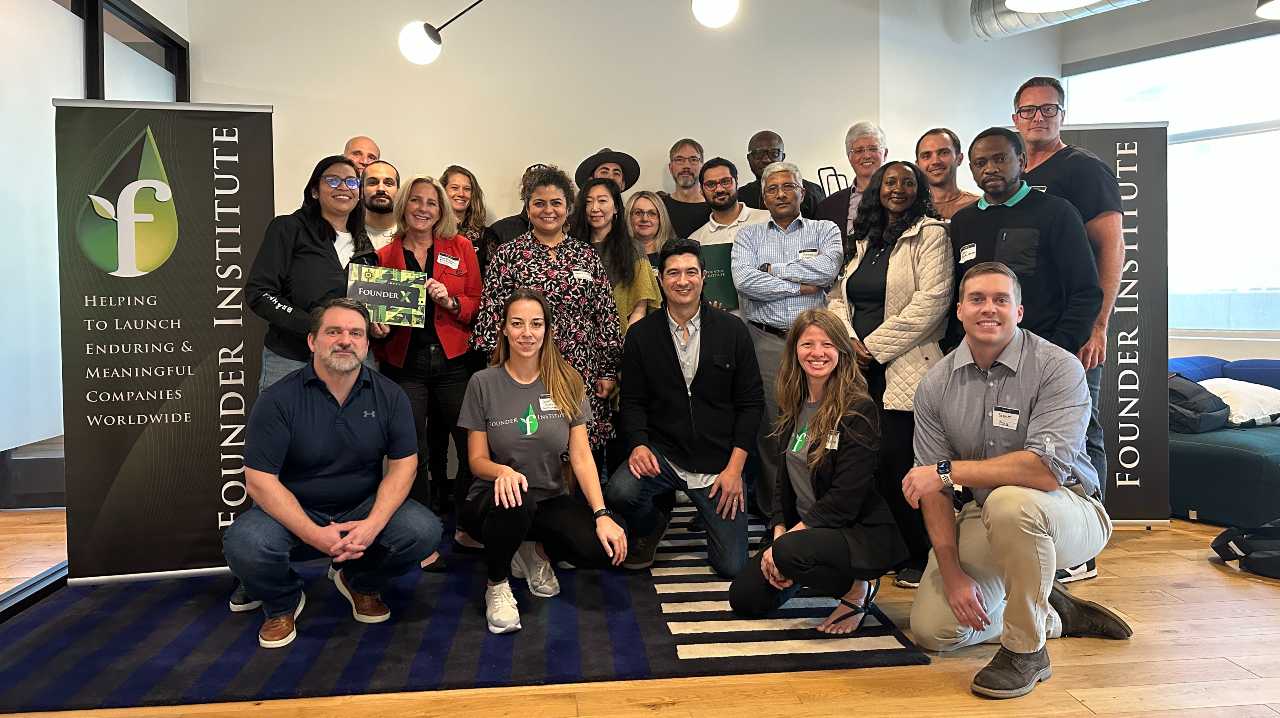
Founder Institute, launched in 2009 and based in Silicon Valley, now runs as the world's largest AI-native company builder, and its entire reason for existing is to get individual founders to unicorn potential while sparing them the isolation that quietly ends most one-person companies.
Join and you walk in with free, startup-trained AI agents and AI founder tools that behave like a first team, a stage-based curriculum that meets you where you actually are each week instead of marching everyone toward one funding day, and clear routes to first capital through funding days and local funds.
The network reaches 200+ cities and 95 countries, and since 2009 its founders have built more than 9,000 companies that have raised over $2 billion and produced 200+ exits. Its shared-upside Equity Collective also keeps your local leaders and mentors financially tied to how well you do long after you finish, with over $8.5M already distributed back through that network.
The Bottom Line
Knowing how to build a unicorn with AI agents is not about owning the best model or the cleverest prompt.
It comes down to a disciplined sequence: find an expensive problem, prove an agent can solve it reliably, build your team as agents, defend what you build, chase learning over motion, raise on your own terms, and refuse to do it alone.
AI tools are a commodity. Your judgment, and the company you keep while you build, are the edge.
Apply to Founder Institute and start building your unicorn.