

In 2019, fewer than one in four new startups had a single founder. By the first half of 2025, that number had climbed past one in three. Carta's Solo Founders Report tracked the rise from 23.7% to 36.3%, and the reason is easy to spot. AI agents can now write code, size a market, and draft a sales sequence before lunch. The team you once needed just to get started fits inside a laptop, and the AI startup playbook has been rewritten as a result.
The same report has a twist, though. In 2024, solo founders started 30% of new companies but received only 14.7% of the cash raised in priced equity rounds. Building got cheap. Convincing someone to back what you built did not.
That gap is where the new playbook starts. When anyone can ship a product in a week, the winners will not be the founders with the longest list of tools. They will be the ones who know what to build, in what order, and who needs to see it.
The old rules of starting up are gone
For years, starting a company followed a familiar script. Spend six months on a first version. Raise money to prove the idea. Find a co-founder and hire a team before writing a line of code.
Founder Institute's FI Agentic program flips each of those rules on its head.
Six months to a first version is now an MVP this week. Getting a product out the door is the easy part. Choosing the right one is where founders win or lose.
Raising to prove the idea is now proving it, then raising from strength. Founders can bootstrap to real metrics first, then walk into investor meetings with numbers instead of promises.
A team before you start is now optional. Agents can carry a single founder to first traction and even first funding. That shift is a big reason the solocorn, a one-person company chasing a billion-dollar outcome, has moved from thought experiment to serious conversation.
So if skills are no longer the barrier, what is?
Why tools alone won't build your company
Founder Institute CEO Connor Sattely answers that in the FI manifesto: "A founder with agents and no direction builds an impressive demo for a problem nobody has."
It is an easy trap to fall into. AI makes it effortless to look productive. A landing page, a pitch deck, and a hundred cold emails can all appear in a single afternoon. None of it counts if the problem is wrong, the customer is fuzzy, or the steps happen in the wrong order.
What agents cannot supply is judgment. Which problem is worth solving? Which move turns a product into revenue? What does it take to sell in your city, to your buyers, under your local rules? The manifesto adds a line that connects straight back to the Carta numbers: "Early-stage belief is a limited resource." Agents can help you earn that belief. They cannot hand it to you.
The new AI startup playbook, step by step
The founders getting real traction today tend to move in the same five steps. Agents help with every one of them, but none of them can be handed over completely.
Step 1: Get a plan made for your company
A course gives every founder the same syllabus, and a chatbot only produces a good plan if you prompt it perfectly, every time. The better starting point is a plan built around your stage, market, and traction, one that changes order as your company does. Inside FI Agentic, that is the role of the Playbook, which re-plans your Sprints each week. Land a pilot, and sales moves up the list.
Step 2: Let agents clear the busywork
Agents are at their best on the repetitive work that eats a founder's week: first drafts, research, follow-ups, and reminders. FI builds this in through Frank, an always-on sidekick that connects to tools like Gmail, Calendar, Asana, and Stripe, and AI Assist, a button on every deliverable that drafts, researches, or critiques. The judgment still stays with you. That is the whole point of the split.
Step 3: Prove it before you raise
The new playbook puts traction ahead of fundraising, and the FI Agentic sessions follow that order. Founders get a landing page live during Validation, test pricing in the Model session, and chase paying customers at Launch. By the Traction session, the target is 10% growth every week.
Recent graduates show what that looks like. Donna Vincent Roa of MicDots, from the Silicon Valley AI cohort, began with a construction deployment at one site, and the customer then asked her to roll out at two more. Stephan Aarstol, from the Southern California cohort, built the whole TheCutList.com platform on his own in roughly four months.
Step 4: Rehearse until the tough questions stop being scary
Remember the Carta gap. It is not about building. It is about persuading. A founder who has already been grilled dozens of times walks into the real meeting with a calm that is hard to fake. FI's Pitch Gym gives founders that practice with a voice agent playing the investor, and according to FI, founders log 20 to 40 reps before Funding Day.
Step 5: Surround the agents with real people
This is the part a chatbot cannot replace. In FI Agentic, mentors rate each founder's progress every week, and the program builds toward a Funding Day pitch in front of angels and VCs.
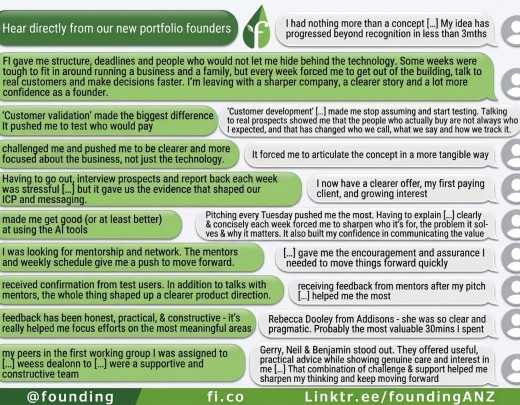
Daan Weddepohl, founder of Sellster and previously Peerby, shows why that human layer matters. He credits his cohort, and Founder Institute's Adeo Ressi pushing hard on market size and scope, for cutting a broad marketplace idea down to a single focused product. No agent was going to have that conversation with him.
Want the full picture of every tool and session? The FI Agentic program page breaks it all down.
A week inside the new playbook
Here is a composite week from the Silicon Valley AI cohort, as shared on the FI Agentic page.
Monday opens with Frank flagging three deliverables due Thursday while AI Assist drafts a pricing interview script. Tuesday brings two customer interviews lined up by an outreach agent, plus two late-night Pitch Gym rounds with an early-stage VC. Wednesday includes a 30-minute mentor office hour, and Frank surfaces replies from outreach with follow-ups ready to send. Thursday is the live Feedback Session with the cohort and mentors. Friday, mentor ratings land and the Playbook adjusts, pulling the sales Sprint forward. Saturday is a working group plus three more practice pitches, this time to angels. Sunday is a day off.
Altogether, that adds up to roughly 15 to 20 hours a week, rising in the final stretch before Funding Day.
Can you really start a unicorn this way?
No program can promise a billion-dollar outcome, and any that does deserves a raised eyebrow. What the new playbook can do is tilt the odds your way: ship fast, prove demand early, sharpen your pitch, and get in front of the right people at the right moment.
Founder Institute has been building that human side since 2009, with 200+ portfolio exits so far, and the bar is high. Fewer than 40% of accepted founders make it to graduation.
Write your own playbook
Waiting for the perfect co-founder or a finished product is part of the old script. All the new one asks for is an idea worth chasing and the willingness to put in the work.
Applications are open for upcoming FI Agentic cohorts, which launch throughout the year in 200+ cities, and the application takes about 15 minutes. Apply to Founder Institute to get a Playbook shaped around your startup, agents that clear the busywork, and a network ready to help turn early momentum into funding.