

There is a palpable uneasiness that I feel these days, and most people I speak with feel the same way.
This anxiety doesn't exist in a vacuum. It sits on top of years of accumulated stress from geopolitical instability, wars that feel closer than they should, inflation that continues to erode savings, and a pandemic that rewired how we think about work and security.
The Scale of What's Happening

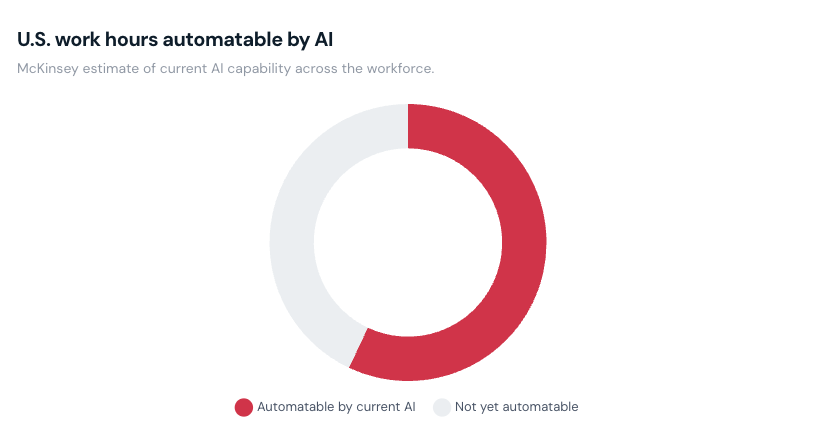
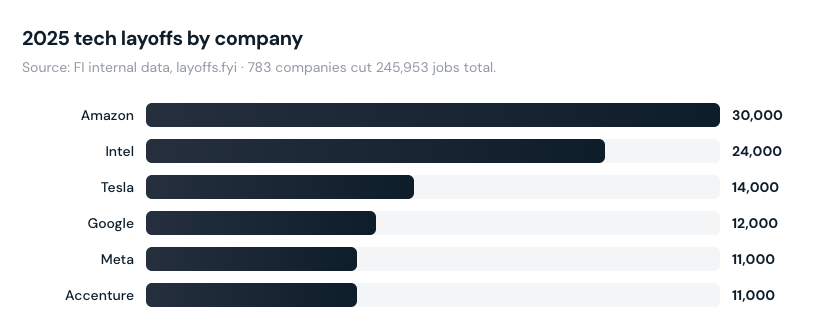

This isn’t a bug in the system. This is the system working exactly as it should.
An organization with shareholders needs to maximize profit. A shareholder’s job is to keep them accountable.
AI is giving everyone an efficiency and profit-generating tool for the ages, and shareholders are demanding their companies become more efficient. That’s how the avalanche of layoffs begins, and I don’t even think we’re at the snowball stage yet.
The Identity Crisis Beneath the Anxiety
The job loss numbers, as staggering as they are, only tell part of the story. In particular, the statistics miss the emotional dimension, and don't even begin to touch how this moment is reshaping the way people think about themselves.
I've talked to dozens of professionals in the last few months who all describe the same feeling: a sense that the ground is shifting beneath them in a way they can't control. Not panic, exactly. More like a persistent unease. A question that keeps surfacing: Where do I fit in what's coming?
Our very sense of self-worth is eroding.
For decades, most professionals built their sense of self around what they knew how to do. The lawyer who spent years mastering contract negotiation. The financial analyst who could build a model faster than anyone on the team.
"What do you do?" In our culture it is often just another way to say "who are you?"
Healthy or not, that is the reality for most people.

The Only Way Forward Is Through
I want to be very direct here, but also very honest about the compassion this moment requires.
What you're feeling is completely valid. I'm feeling this anxiety every day, and the uncertainty is real. Nobody should minimize the difficulty of having the professional identity you've spent years building called into question.
The people who spent decades building expertise in fields that are now being automated didn't do anything wrong. They worked hard, they got good at what they did, and then the rules changed. That deserves acknowledgment, not dismissal.
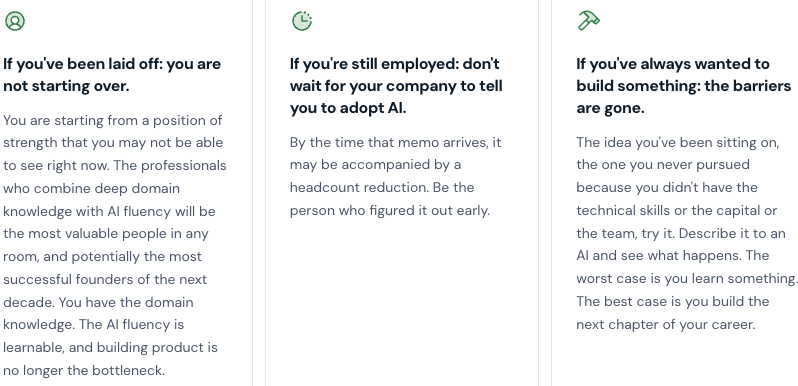
But the rules have changed, and the only path forward is reinvention. Reinvention begins with educating yourself.
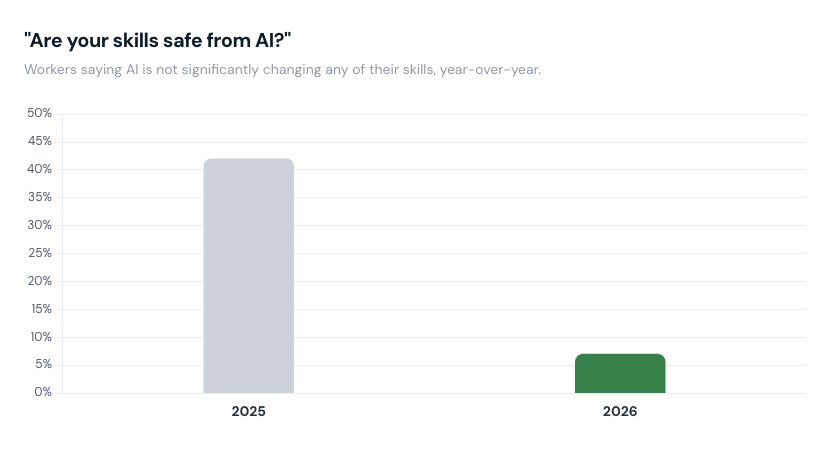
Staying the same is not a strategy. Waiting for things to "go back to normal" is not a strategy. Hoping your particular role or industry or skillset is somehow immune is not a strategy. The JFF survey found that only 7% of workers now say AI is not significantly changing the importance of any skills, down from 42% just a year ago. In twelve months, we went from most people thinking their skills were safe to almost everyone acknowledging they aren't.
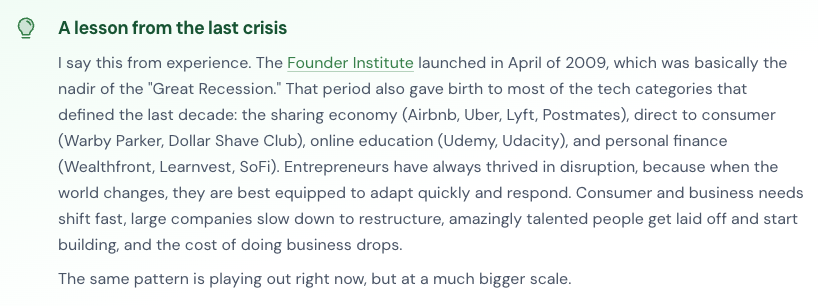
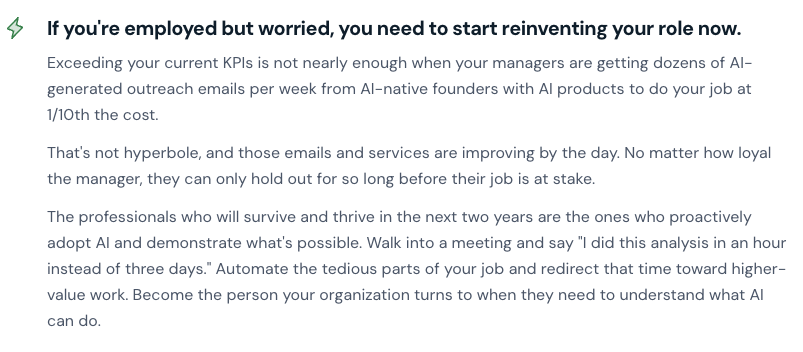
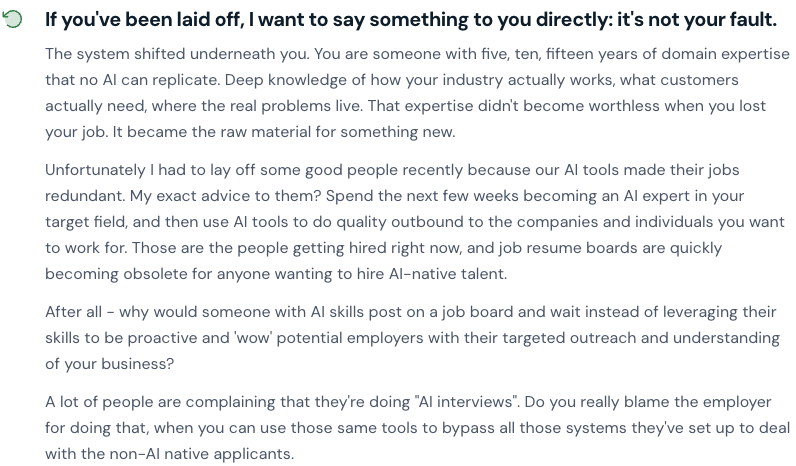
The reinvention looks different depending on where you sit.

The Same Forces Creating the Crisis Are Also the Solution
This is where the story gets interesting, and where I think the real opportunity lives.
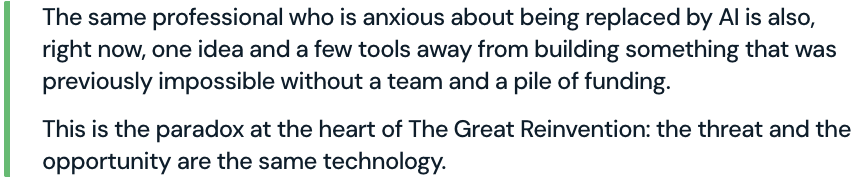
The very same AI capabilities that are causing this collective anxiety are also creating the most accessible window for creation and entrepreneurship in human history.
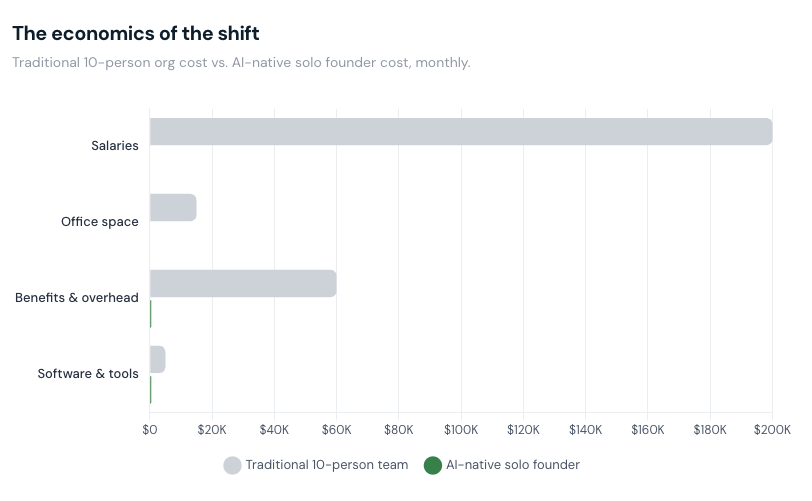
Peter Diamandis, the founder of the XPRIZE and a leading voice on exponential technology, calls this moment "the organizational singularity," the point at which a single person with AI can outcompete an entire traditional organization. He points to companies shrinking to 20% of their current size while entrepreneurs spawn five times as many startups. When your "employee cost" is $200/month in AI subscriptions instead of $20,000/month in human salaries, the competitive dynamics of entire industries change overnight.
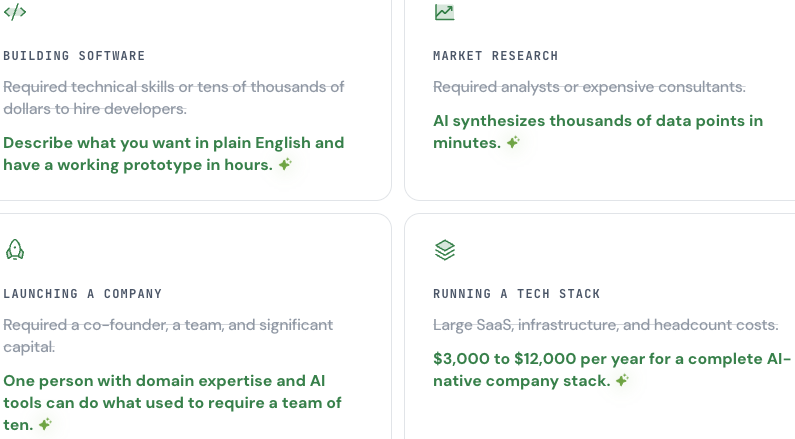
Think about what this means practically. A year ago, building a software product required either technical skills or tens of thousands of dollars to hire developers. Today, you can describe what you want in plain English and have a working prototype in hours. A year ago, conducting deep market research required analysts or expensive consultants. Today, AI can synthesize thousands of data points in minutes. A year ago, launching a company required a co-founder, a team, and significant capital. Today, one person with domain expertise and the right AI tools can do what used to require a team of ten.
What changed in 12 months
The democratization of creation is happening in real time.
No co-founder needed. No technical background required. No VC needed to validate.
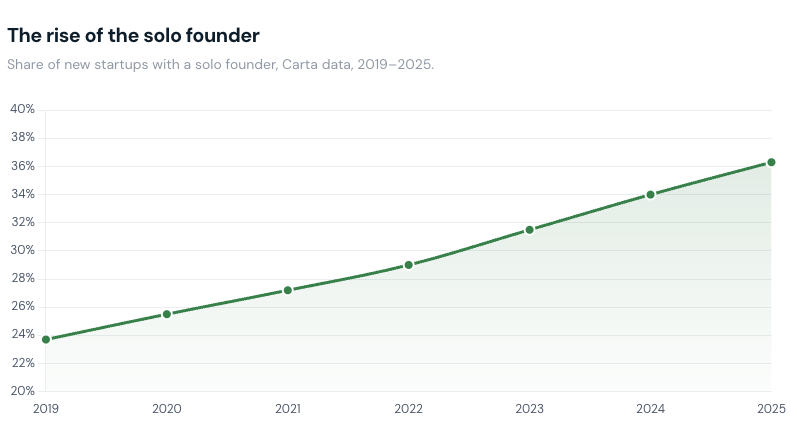
The data backs this up. According to Carta's 2025 Solo Founders Report, the share of new startups with a solo founder has jumped from 23.7% in 2019 to 36.3% in 2025. More than one in three new companies are now started by a single person. There are now over 41.8 million solopreneurs contributing $1.3 trillion to the U.S. economy annually. Companies are reaching $1 million or more in annual revenue with zero to three employees. And a complete tech stack to run an AI-native company now costs between $3,000 and $12,000 per year.

As Jumpstart Magazine reported in May 2026, the "one-person unicorn," a billion-dollar company run by a single founder, is no longer a contradiction in terms. A founder in Austin reached $20 million in annual revenue with zero employees. A former Stripe engineer in Bangalore runs a payment startup serving 400 merchants, alone. These are early signals of a structural shift that is just beginning.
The Age Advantage No One Is Talking About
Our culture insists that startups belong to twenty-somethings in hoodies. The college dropout, the dorm-room genius, the Mark Zuckerberg of it all. That image has shaped a generation of venture capital, founder programs, and a quiet, grinding self-doubt for anyone over 35 who wondered if their window had closed.
The image is wrong.
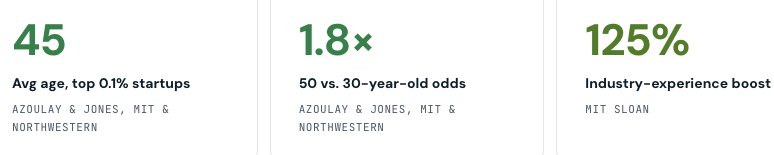
The most comprehensive research on founder age, by Pierre Azoulay of MIT and Benjamin Jones of Northwestern, analyzed 2.7 million U.S. founders. The average age of founders of the top 0.1% fastest-growing startups was 45. A 50-year-old founder is 1.8 times more likely to build a top-growth company than a 30-year-old. Founders in their early 20s have the *lowest* likelihood of building a top firm of any age group. MIT Sloan reports that entrepreneurs are 125% more successful when they previously worked in the industry they're building in. Industry knowledge is the single biggest predictor of whether a startup makes it.
For two decades, the bottleneck for the experienced operator was execution. They had the network, the capital, the pattern recognition. What they didn't have was the ability to ship software, run paid acquisition, or stand up a data pipeline. The fix was to find a 25-year-old technical co-founder, give them half the company, and hope the chemistry worked. That bottleneck just collapsed. A 48-year-old former ops VP can describe a workflow tool to Claude and have a working prototype by Friday.
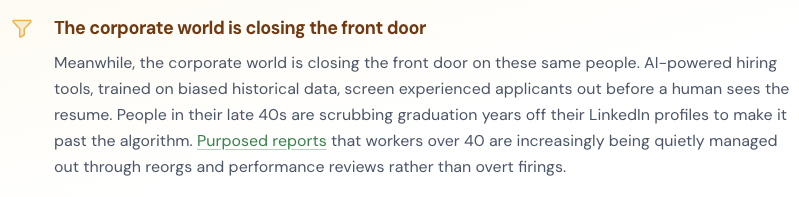
So here's the full picture. The people best equipped to build the next generation of companies are being pushed out of the corporate jobs that used to absorb them, at exactly the moment the tools that used to require a technical co-founder and a seed round became available for the price of a credit card.

What Comes Next: The Million-Startup Economy
If the trends hold, and there is no credible evidence that they won't, here is what the next few years look like.
A massive surge in lean, AI-native companies.
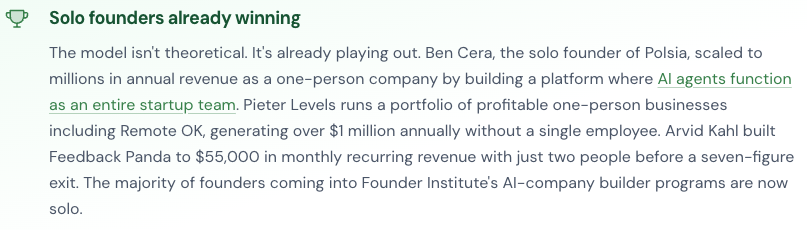
We are heading toward an economy with over a million new startups of one to five people, augmented by AI agents. These won't all be lifestyle businesses or side projects (though some will start that way). They will be real companies generating real revenue, solving real problems, competing with incumbents who are still debating whether to adopt AI. When your overhead is near zero, your margins are extraordinary. When your team is you and your AI agents, your speed is unmatched.
The rise of the "AI Round"
Employees become intrapreneurs.
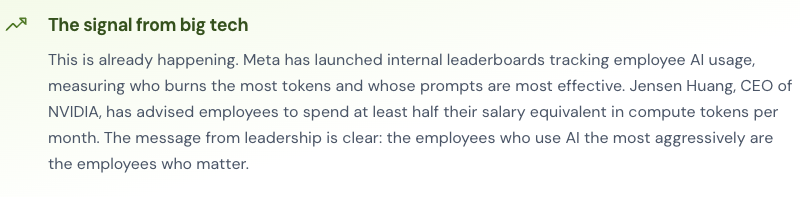
Inside larger organizations, the people who thrive won't be the ones doing the same job they did last year. They'll be the ones who reinvent their roles, orchestrating AI agents to run entire workflows, launching new revenue streams, building internal tools that eliminate entire departments of manual work. The employee of 2027 looks less like a specialist executing tasks and more like an operator running a small business within a larger organization.
Entrepreneurship is the most future-proof skillset.
New categories of work emerge.
"AI fleet orchestrator." "One-person conglomerate CEO." "Agent workflow architect." These sound like made-up titles today. They'll be common job descriptions within two years. The World Economic Forum's projection of 170 million new roles by 2030 isn't wishful thinking. It's what happens when you give seven billion people access to tools that turn ideas into reality.
Start Now
I want to end with something personal, because I know how overwhelming this can feel.
The Great Reinvention is not optional. It is already underway. Industries are restructuring. Companies are shrinking and multiplying at the same time. Roles that existed two years ago are disappearing, and roles that didn't exist two years ago are becoming essential.
None of this is fair in the way we'd like it to be. Nobody asked for this level of disruption.
But the rules have changed. And the only reasonable response is to change with them.
The good news, and I really do mean this, is that the tools for reinvention are more accessible than at any point in history.
You don't need a computer science degree to build software. You don't need an MBA to launch a company. You don't need a team, or funding, or permission. You need curiosity, domain expertise, and the willingness to spend an hour a day learning to use the most powerful tools humanity has ever created.
The Great Reinvention is going to happen whether we participate or not.
The question is whether you'll be someone who shaped it or someone who was shaped by it.
The window is open. The tools are here. The only thing standing between you and your reinvention is the decision to start.
Written by Jonathan Greechan, Co-Founder & CEO of Founder Institute