
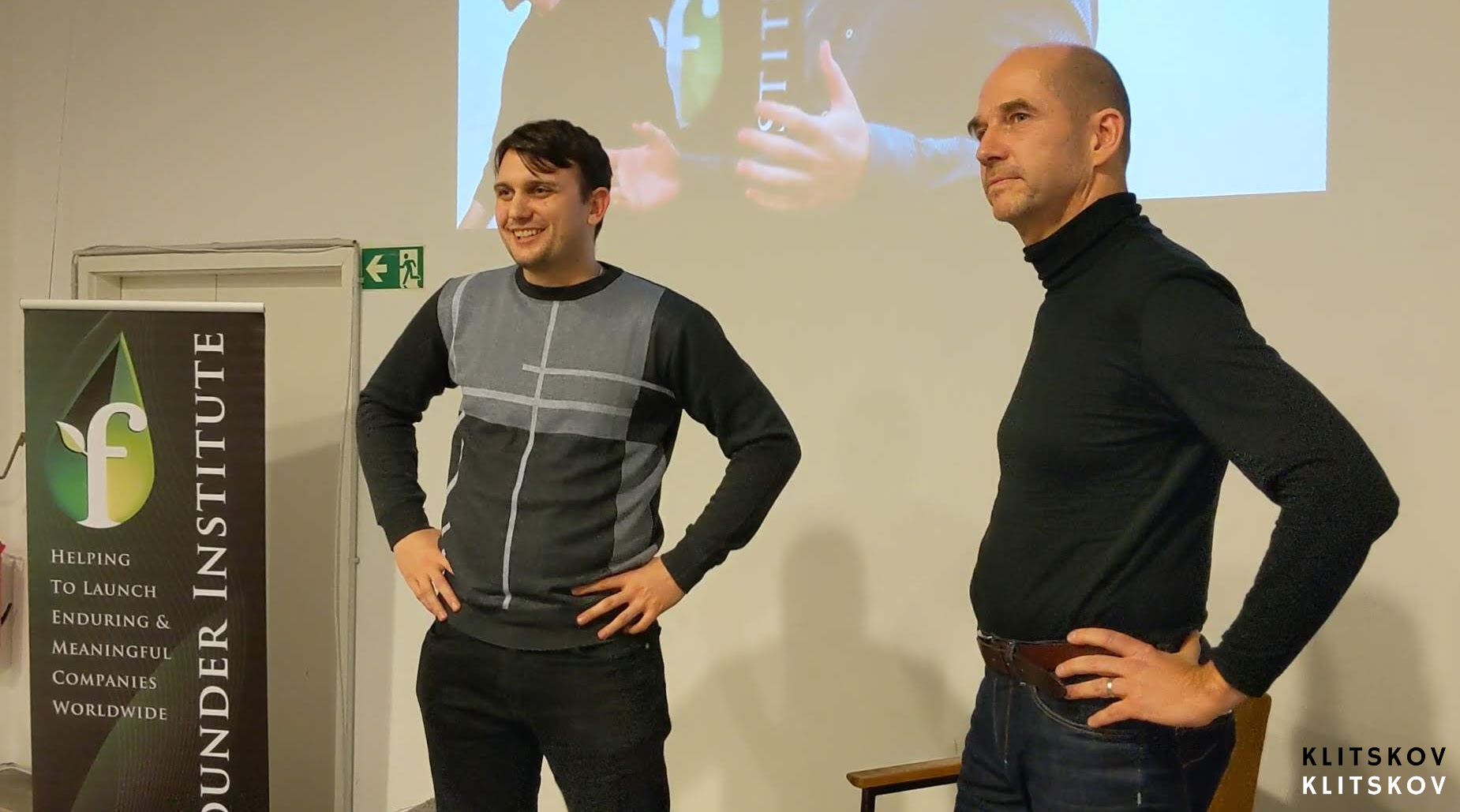
In a keynote at the "Social Entrepreneurship on Campus" event hosted by FernUniversitat Hagen in Berlin, Kai Malkwitz, Co-Director of Founder Institute Berlin, opened with a statement that deserves to be taken seriously: by 2040, it will be virtually impossible to imagine a globally relevant company that does not operate with impact at its core.
This is not idealism. It is a structural argument about where economic value is moving and what it will take to build and sustain a world-class company in the decades ahead. The talk, which you can watch in full here, covers three interconnected ideas that every founder, accelerator operator, and university innovation program should understand: the execution gap that is holding European entrepreneurship back, the role of new businesses as the engine of employment growth, and the ecosystem model that determines whether potential founders actually become real ones.
The World's Most Valuable Companies Were All Founded in the Last 50 Years. Almost None From Germany.
Malkwitz opens his analysis by pointing to the list of the most valuable companies in the world. Nearly every one was founded in the last 50 years. And of the German entries, only SAP appears, sitting around position 50 on global rankings, and SAP itself is over 50 years old.
This is not purely a function of market size. Germany has the conditions that should produce world-class companies at scale. Education levels sit above the OECD average. German universities are recognized globally. In patent applications, Germany ranks second in the world, and first per capita. Political stability is high. The investment environment, while not as developed as in Anglo-Saxon markets, is workable.
So what is missing? Malkwitz is direct about it: execution. Germany has the research, the talent, and the ideas. What it lacks are the ecosystems that transform those inputs into operating businesses. The Achilles heel, in his framing, is not knowledge or capital or infrastructure. It is the gap between knowing and doing.
This diagnosis matters well beyond Germany. It applies to most of Europe and to many regions globally that have invested heavily in innovation infrastructure while underinvesting in the structures that help founders actually move from idea to market. Building a university or a research center or an innovation district is not the same as building the conditions for entrepreneurship. The highway exists. The onramps do not.
The 2040 Thesis: Extractive Business Models Are Running Out of Time
The second major argument Malkwitz makes is about the trajectory of global business over the next 15 years. His claim is not that impact entrepreneurship is a nice-to-have or a values-driven preference. It is that by 2040, the extractive model of business, the model that optimizes purely for extraction of value without regard for what it depletes, is structurally at an end.
He describes this as already visible and accelerating. The most durable companies are those that create value rather than extract it, that build rather than consume. For founders thinking about ventures that could attract external investment, scale internationally, and potentially connect to a larger partner or acquirer, this trajectory is not optional information. It is the operating context for any serious 10-year vision.
The opportunity embedded in this transition is significant. Europe, and Germany specifically, has the research depth and the engineering precision to build impact-oriented companies that lead global markets. The missing ingredient is not capability. It is the entrepreneurial mindset and the ecosystem support structures that turn capability into companies.
This is precisely what programs like Founder Institute, now operating in over 100 countries across approximately 150 chapters worldwide, are designed to address. The global network exists specifically to help founders navigate from potential to implementation, in every kind of market and regulatory environment.
New Businesses Drive All Employment Growth. Established Companies Are Net Killers of Jobs.
One of the most striking data points in Malkwitz's presentation is about employment. In periods of economic transformation, which he argues is not a temporary phase but an ongoing condition of the modern economy, the foundation of stable employment growth is new businesses. Not existing large companies. New ones.
He makes the point directly: established large companies are net employment killers. Their profits may rise. Their revenues may grow. But the number of people working for them is declining. Automation, efficiency, consolidation. The employment growth in any economy comes from new business formation, whether that is a technology startup or a new bakery opening on a local street. Both are new companies. Both contribute to a healthier employment base in ways that corporate optimization cannot.
This reframes the entire case for investing in entrepreneurship ecosystems. Supporting new business formation is not a secondary economic development strategy. It is the primary driver of the job creation that elected officials, development agencies, and communities are trying to produce. You cannot get there by optimizing existing large employers. You get there by making it possible for more people to start more companies, and by giving those companies the ecosystem support to survive and grow.
It Takes a Village to Raise a Startup: The Ecosystem Model
Malkwitz uses a phrase that captures the structural argument well: it takes a village to raise a child, and it takes an ecosystem to raise a startup. This is not a metaphor about warmth or community spirit. It is a functional description of what a working entrepreneurship ecosystem actually does.
The ecosystem Malkwitz describes has four sequential layers, each of which must be present and connected for the whole to function:
Education. Founders need foundational knowledge about business, markets, and the mechanics of building a company. Universities and educational programs provide this. But education alone produces graduates with knowledge, not companies with customers.
Identification. There are far more potential founders in any population than there are actual founders. The gap is not talent. It is identification and activation. Tools like the Entrepreneur DNA Assessment, developed over 16 years of PhD-backed research, exist specifically to find entrepreneurial potential in people who have not yet recognized it in themselves. Malkwitz cites identification as one of the most decisive factors in FI's program design, because focusing on the right person from the start determines everything that follows.
Activation. Identifying potential founders is not enough. Activation means helping people make the decision to build, and then giving them the structure to take the first concrete steps. This is the transition from intention to action, and it is where most ecosystem models fail. Inspiration without structure produces motivated people who do not know what to do next.
Acceleration and Scale. Once a founder is building, they face a continuous sequence of decision points under conditions of near-total uncertainty. An accelerator's job is to make sure founders do not get stuck at those forks in the road. FI's 14-week Agentic program, distributed across approximately four months, is designed around exactly this challenge: helping founders move from vision through go-to-market strategy to team building, in a structured sequence that surfaces the decisions that matter most and helps founders make them faster.
Focus Is the Most Underrated Entrepreneurial Skill
One of the most practically useful sections of Malkwitz's talk is about focus, illustrated through the story of N26. The German digital bank started as a parental control banking app, designed to give parents oversight of their children's accounts. The parents were enthusiastic. The children, who were the actual users, were not. They had no interest in giving their parents visibility into their spending.
So N26 pivoted. They stripped the product down to one thing: making a bank transfer simple. Every traditional bank laughed. Then they stopped laughing.
The lesson Malkwitz draws is about what founders get wrong most consistently. They try to solve five problems simultaneously, serve three customer groups at once, and build two business models in parallel. The result is that they solve none of them well enough to earn traction, and they exhaust their limited resources doing it.
The FI program is deliberately structured around the opposite approach. One problem. One customer group. One product. One core feature. One business model. Not as a permanent constraint, but as the starting discipline that makes it possible to validate assumptions quickly, identify what works, and build from a position of clarity rather than scatter. A founder who can do one thing excellently has a foundation. A founder trying to do five things simultaneously has a hypothesis that is impossible to test.
Malkwitz frames this as a decision-making framework under uncertainty. Founders make decisions constantly, under conditions where the information they need rarely exists in advance. The structured approach FI uses, formulating explicit assumptions and then systematically verifying or falsifying them, gives founders a way to move forward without pretending they have certainty they do not have. Clarity about what you are testing replaces false confidence about what you know.
The University-Accelerator Partnership: Where the Real Potential Sits
The final major theme of Malkwitz's talk is the largely untapped potential of deeper integration between universities and accelerator programs. His argument is not that universities and accelerators are doing separate things in parallel. It is that they are currently doing parallel things when they could be doing interconnected things, and the difference in outcomes is enormous.
Universities have an exceptional pipeline: highly capable students, world-class research output, and a mandate to produce knowledge. What they structurally struggle to provide is the transition from knowledge to implementation. The ideas that come out of university environments and then fail in implementation do so, in Malkwitz's experience, because the connective tissue between education and execution was absent. Not because the ideas were bad.
Accelerators like Founder Institute, which works with government organizations and universities in addition to individual founders, are positioned to provide exactly that connective tissue. The identification and activation layers of the ecosystem model can be embedded within educational programs. Students can be assessed for entrepreneurial potential, connected with structured startup methodology, and linked to the mentor and investor networks that accelerators provide, all before they leave the academic environment. The result is not just more startups. It is a stronger ecosystem in which the talent universities develop actually stays in the local economy and builds within it.
This is the "village" Malkwitz describes. Not a collection of institutions operating in their own lanes, but a connected system in which each element reinforces the others. Education produces informed potential. Identification finds the right people. Activation gets them moving. Acceleration keeps them moving. And scale connects them to the capital and networks that let their work compound over time.
Entrepreneurial potential is everywhere. The infrastructure to unlock it is what determines whether that potential becomes companies, jobs, and economic value, or remains potential. Learn more about how Founder Institute works with universities and ecosystem partners, or apply to join a cohort and begin building with the structure, network, and methodology that the ecosystem model requires.